The growing pressure on UK CFOs to adopt AI

There's an old saying in business. What gets measured gets managed. But today, UK CFOs are discovering a harder truth. What doesn't get automated gets left behind. Across British boardrooms, the pressure to adopt artificial intelligence has stopped being a strategic conversation and started being a performance expectation.
But the pressure on CFOs isn’t to blindly trust AI with financial decisioning. It’s to understand where AI augments judgment versus where statistical certainty still matters.
AI adoption is becoming a competitive necessity
The data is unambiguous. According to Deloitte's UK CFO Survey, digital transformation, including AI, has become a top strategic priority for a growing proportion of finance leaders, driven by the relentless push for productivity gains and cost efficiency in an uncertain economy.¹
PwC echoes this shift. Their research shows UK CFOs are increasingly expected to act as transformation drivers, not just financial stewards. Automation and AI are no longer tools for the forward-thinking few — they're the standard operating expectation for anyone serious about modernising finance.²
To put it simply, AI adoption isn't framed as innovation anymore. It's framed as survival. But survival requires clarity and right now, the finance sector is missing a critical distinction.
Augmentation versus decisioning
Not all AI in finance is the same. And conflating the two categories is where organisations are getting into trouble.
A CFO using AI to summarise exposures, identify anomalies, draft commentary, monitor collections, interpret filings, and accelerate workflows is doing something fundamentally different from deploying an AI model to autonomously determine probability of default, credit limits, insolvency risk, or underwriting decisions.
The first is augmentation. The second is statistical decisioning.
And statistical decisioning has always depended on something that modern large language models are not inherently designed to provide such as historical outcome datasets, calibrated models, back-testing, validation cohorts, stability testing, explainability, and the ongoing monitoring of model drift. LLMs are probabilistic language systems. They are powerful at interpretation. They are not actuarial engines. Treating them as one is where credibility and regulatory defensibility breaks down.
That's the real unresolved tension in finance right now. CFOs increasingly trust AI to help interpret risk. But they do not yet fully trust AI to originate the underlying risk model itself. That distinction is important. And it's actually where sophisticated finance organisations are drawing the line:
- AI for interpretation: yes
- AI for orchestration: yes
- AI for workflow acceleration: yes
- AI as sole underwriting authority: not yet
Multiple recent CFO surveys reflect this trust gap directly, with finance leaders citing concerns around:
- Hallucinations
- Explainability
- Data integrity
- Governance
- Regulatory defensibility
- Auditability
- Model reliability
These aren't reasons to avoid AI. They're reasons to be precise about where it belongs.
Regulatory and governance pressure is increasing
The pressure isn't just coming from inside the building. UK regulators are raising the bar too. The Financial Reporting Council has made clear that data governance, controls, and auditability matter — implicitly pushing finance leaders toward more advanced, AI-enabled infrastructure.³
The Bank of England has been equally direct, acknowledging both the opportunities and the risks of AI in financial decision-making, and stressing that firms must build robust oversight frameworks as adoption scales.⁴
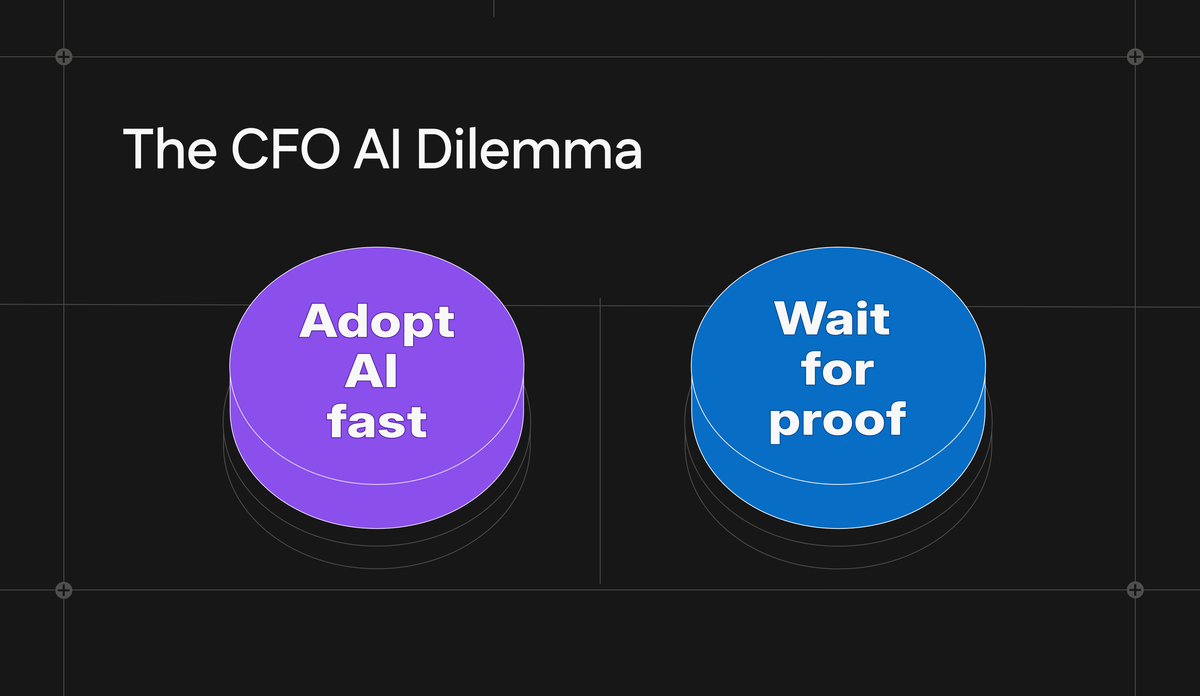
For today's CFO, this creates a double bind. Adopt AI fast enough to stay competitive, but carefully enough to satisfy regulators who are watching closely. The organisations that thread that needle will be the ones that understand where AI augments judgment versus where statistical certainty still matters.
Investor expectations are shifting
Investors are turning up the heat too. EY's research shows UK finance leaders facing growing scrutiny from stakeholders who want faster reporting, sharper insights, and more predictive forecasting.⁵
AI is the clearest path to delivering all three, but only when it's applied to the right layer. Faster interpretation of risk signals, earlier identification of exposure changes, and smarter prioritisation of where human attention goes. These are where AI is already delivering measurable value. Investors want the insights AI makes possible. They still want humans, and validated systems, making the final calls on credit.
For companies that fail to modernise, the consequences aren't just operational. They're reputational. In private equity and high-growth environments especially, data-driven decision-making has shifted from differentiator to baseline expectation. Show up without it and you're already behind.
Internal efficiency demands are rising
Inside organizations, the mandate is just as loud. Finance teams across the UK are being asked to handle larger data volumes, compress reporting cycles, and deliver forward-looking insights rather than historical summaries — all without adding headcount.
KPMG's research confirms CFOs are turning to AI and automation to eliminate manual processes and free their teams for higher-value strategic work.⁶ Reconciliations, anomaly detection, forecasting. These are increasingly machine jobs now. The humans are being asked to do something harder — think.
This evolution is fundamentally reshaping the CFO's role, from scorekeeper to strategic co-pilot.
Credit control, AR, and collections are becoming core AI use cases
Nowhere is this shift more visible, or more immediate, than in accounts receivable and collections. These teams sit at the intersection of cash flow, customer relationships, and risk management. They're being asked to improve collections, reduce overdue balances, shorten DSO, and manage customer risk with fewer people and less manual effort. That's a tall order without the right tools.
AI is a natural fit because AR and collections work is data-heavy, repetitive, and judgment-based, exactly the kind of work that intelligent augmentation handles well. Finance teams are increasingly using AI to predict which invoices are most likely to become overdue, prioritise collection activity by risk and value, recommend the best timing and tone for customer outreach, identify payment disputes earlier, detect unusual payment behaviour, support cash-flow forecasting using customer payment patterns, and automate invoice matching, remittance processing, and query routing.
But this is where the augmentation versus decisioning line also matters — AI surfacing a signal about a counterparty's changing payment behaviour is very different from AI making an autonomous lending decision based on that signal. The first makes credit professionals faster and sharper. The second introduces risk that most governance frameworks, regulators, and risk committees aren't ready to underwrite.
For credit controllers, the opportunity is real. Faster cash collection, lower manual workload, and sharper visibility into working capital. But so is the responsibility. Controllers now need to understand, validate, and govern AI-supported workflows particularly where AI influences customer communications, prioritisation, or escalation decisions. The job is no longer about manually identifying who to chase next. It's about deciding how AI recommendations should be applied, when human judgment should override automation, and how collection activity stays fair, consistent, and auditable.
Credit controllers are becoming collections strategists. The teams that make that transition soon will have a measurable advantage.
The talent and skills gap adds urgency
There's one more pressure point that doesn't get enough attention. The talent gap. The UK finance sector is caught between the skills it has and the skills it needs. Traditional accounting expertise is table stakes. What's increasingly required is fluency in data, technology, and AI-driven workflows.
The ACCA has been clear on this. Finance professionals who don't develop digital and analytical capabilities risk being outpaced by the very tools their organisations are adopting.⁷
For CFOs, this makes the timeline even tighter. You're not just implementing technology. You're simultaneously rebuilding your team around it.
From optional to inevitable
The picture is clear. UK CFOs aren't choosing to explore AI. They're being pushed toward it from every direction at once:
- Competitive pressure to improve efficiency and deliver real-time insights
- Regulatory expectations around governance, transparency, and auditability
- Investor demands for faster, data-driven decision-making
- Internal mandates to do more without growing headcount
- A talent gap that makes technological augmentation not a luxury but a necessity
AI adoption in UK finance has crossed a threshold. It's no longer a question of if. It's a question of how fast, how carefully, and — most importantly — where.
Grand gives credit teams AI-powered credit analysis that doesn't just score companies — it explains why, give you early signals that bureau reports miss, and continuous monitoring across your full ledger of partners.
Sources:
- Deloitte, UK CFO Survey
- PwC UK, Guardians of responsible AI: How CFOs can lead in building trust
- KPMG, From pilots to production: Scaling AI across UK businesses
- Financial Reporting Council (FRC), Corporate Governance & Reporting Guidance
- Bank of England & FCA, Artificial Intelligence in UK Financial Services – 2024
- EY, How can the financial controller transform to shape the future with confidence?
- ACCA, Digital horizons: technology, innovation and the future of accounting


